

By: Laura Philips
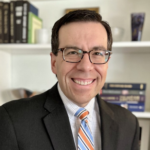
I was delighted that Adam Copeland was not only willing to be interviewed for my final “Get to Know a Member” column, but has also graciously agreed to become the next editor/author of this monthly endeavor. Adam is a partner in the Washington D.C. office of Wilkinson Barker Knauer LLP, which he joined in September 2024. At WBK, Adam provides regulatory and transactional advice and counsel to a wide array of clients in the communications sector. His focus is primarily on issues such as network deployment and related infrastructure and permitting implications, data privacy, FCC enforcement, and broadcast content policy.
Q. What attracted you to the field of communications?
A. I was fascinated by broadcasting as a kid, particularly radio. I remember in sixth grade having to convince one local station to let me shadow one of their hosts because they would only let high schoolers do those types of things (I eventually wore them down and was on cloud nine that day at the station). After some internships in the industry, I decided before I went to college that would ultimately not be my career path, but I chose to minor in broadcasting at GW, and one of my classes was taught by a practicing communications attorney. I had already been thinking about going to law school, and once I learned that communications law was a thing, I knew that was what I wanted to do.
Q. Tell us about the various places you’ve worked through the years.
A. Before I came to WBK, I was at the FCC for 12 years. I started as a staff attorney in the Media Bureau’s Policy Division, which was a continuation of my focus on broadcasting and cable issues during five years in private practice at a couple of firms following law school. After two great years in the Media Bureau, I was looking to diversify both my substantive experience and my level of responsibility. This was right around the time that Netflix had become the largest video content distributor in the U.S. and I realized that my longstanding interest in media was converging with broadband policy. I had an opportunity to do a detail in the Competition Policy Division (CPD) of the Wireline Competition Bureau (WCB) to work on the team for the Comcast-Time Warner Cable (later abandoned) merger, and was then offered the chance to stay on in CPD.
Shortly after that, I became an Assistant Division Chief and later a Deputy Division Chief, fulfilling my aspiration to take on management responsibility. My focus during my five years in CPD was primarily broadband-related—I managed proceedings focusing on infrastructure deployment, most prominently, the 2018 overhaul of the FCC’s pole attachment regulations, and the Bureau’s broadband-related reports, including the inaugural Communications Marketplace Report. In 2019, then-Bureau Chief Kris Monteith asked me to join the WCB front office, where I spent five years as an Associate Bureau Chief and then a Deputy Bureau Chief. In the front office, I continued working on the broadband deployment issues I handled in CPD, but also expanded my focus, including working on broadband policy, consumer data privacy issues involving the FCC’s data breach, SIM swap, and number port-out rules, and implementing the Safe Connections Act to assist survivors of domestic violence in maintaining access to communications. I also gained my first experience with universal service as front office manager of the Rural Health Care and Connected Care Pilot Programs.
I’m incredibly grateful for the various opportunities I had at the FCC. The agency has a unique process by which it develops an item for Commission consideration, and having seen that process play out in my different positions has been a real asset in my current role at WBK when assisting clients to shape their advocacy.
Q. Have things unfolded in your career more or less the way you planned?
A. Somehow I’m now almost 20 years into my legal career, and to be honest, when I was starting out, I don’t think I had a vision for what things would look like 20 years in. The summer after my first year of law school, I interned in the Policy Division of the Media Bureau and had an incredible experience there thanks to the patience and generosity of the division’s attorneys, who included future FCBA President Natalie Roisman. After that, I knew I wanted to go back and work at the FCC. Seven years later, my first FCC job was in that very division, but getting back in the door at the FCC was about as far as my career planning went. Since then, I’ve been fortunate to have a lot of really rewarding career experiences.
Q. What’s the most interesting or challenging thing that you’ve done in your current position?
A. At WBK, we really like our clients to remain in the spotlight rather than their outside counsel, so I’m going to cheat here and use something from my most recent previous role as a Deputy Bureau Chief in the Wireline Bureau. I managed the cross-Bureau and Office team of FCC attorneys and economists that prepared the 2024 Open Internet Order under Chairwoman Rosenworcel. At one point, I realized that we had around 100 people making contributions across at least eight FCC Bureaus and Offices. That proceeding presented probably the most complex set of legal issues I’ve worked on in my career, along with a possibly unparalleled substantive scope for an FCC item that touched on everything from universal service to cybersecurity to disability access to pole attachments and much more. The final item ended up being over 400 pages. And we produced it very quickly by FCC standards: the order was adopted at the FCC’s April 25, 2024 Open Meeting, which was only three months after the formal comment cycle ended, and six months after the adoption of the Notice of Proposed Rulemaking. It really was a monumental achievement to produce… even if it was eventually “set aside” by the Sixth Circuit in January 2025.
With respect to my current role, I will say that this year, I’ve been keeping busy with some very interesting issues with First Amendment implications that I’m very proud to be working on. There are obviously a lot of differences between being a lawyer in the government versus a law firm, but one possibly under-the-radar benefit of private practice for me has been the sense of accomplishment I’ve felt when leveraging my experience to help clients navigate regulatory issues facing their business, sometimes on a day-to-day basis. At the FCC, the Commission and Bureau-level items I was working on were often months or even years in the making, so you had these significant achievements, but there would be a long road to get there. There are definitely some parallels to that in my law firm practice too, but I’m grateful for the smaller wins when they happen.
Q. Is or was there something interesting or someone who surprised or impressed you during your career and why?
A. I’m not sure I can adequately express my appreciation and admiration for all of the outstanding efforts of my former colleagues at the FCC. One of the privileges of being a Deputy Bureau Chief and getting to manage as many different teams as I did is that I saw firsthand the incredible dedication, subject matter expertise, and skill of so many throughout the FCC’s ranks. The agency’s staff truly embodies excellence in public service, and I’m not sure that a lot of people outside the FCC fully grasp how hard many of the staff are asked to work.
Q. What do you enjoy reading?
A. I admittedly don’t get to read for pleasure as much as I used to. I used to read a lot of historical non-fiction—at one point, I churned through all of David McCullough’s books on U.S. Presidents and several others from authors mimicking McCullough’s style. Nowadays, I prefer to read “lighter” non-fiction, which recently has included “Disney’s Land,” an account of how Disneyland came to be, and “Sick in the Head,” a compilation of Judd Apatow’s interviews with notable comedians.
Q. Is there something (a hobby or other tidbit) people don’t know about you that you are willing to share?
A. I’ve been playing pickleball for about 10 years now. During that time, the game has exploded in popularity. The combination of a low barrier to entry (you just need a paddle, a ball, and a place to play), its social aspects, and the game’s acceptance of a wide spectrum of skills and abilities probably explains the phenomenon. When I started playing, I was probably the youngest person I knew who played the game, and I could find only one small group about 15 minutes away that played on tennis nets and had to chalk the court lines for pickleball before we could play. Nowadays, I’ll see players of all ages playing and there are multiple places near me with permanent, dedicated pickleball courts.
I find it to be a very analytical sport—when played at a higher level, the sport requires you to constantly make strategic decisions about the right type of shot to hit—and I really enjoy both the physical and mental aspects of playing. This year, a group of us played at the FCBA Annual Seminar, and hopefully it’s a bigger group next year!
Q. Can you share your perspective on the pitfalls to avoid or other career advice for those who are just getting started in the communications field?
A. I can’t overemphasize the importance of effective communication skills. For instance, I’ve seen too many younger attorneys, summer associates, and interns trip up on an assignment because they failed to ask the right questions when they met with the attorney assigning them the project. I think sometimes more junior folks either feel intimidated by more senior attorneys or think they will be perceived poorly if they ask a question that seems uninformed. These are very natural feelings (I’ve felt them myself), but it’s really important to work through them to get the answers you need (the content you need to produce, the type of deliverable, your deadline, client expectations, etc.) rather than making assumptions and getting any of that wrong. In communicating with more senior attorneys, you want to ensure you’re not overpromising and underdelivering, but if you ever find yourself in an unfortunate spot where you’ve done that—for instance, realizing that you’re not going to deliver a work product when you said you would—touch base with your supervising attorney ASAP so that you can work together to mitigate the problem.
Effective communication is also essential for your professional development. Hopefully you will find mentors to guide you and have career experiences where you’re surrounded by supportive colleagues, but at the end of the day, it’s up to you to ensure that you’re getting the professional experience that you want. So, if there are substantive issues that you aren’t working on but want exposure to, or you’re looking for increased responsibility or a different type of role, don’t assume others are aware that you want those things or that they will just be handed to you. Consult with mentors and trusted colleagues about who you need to talk to in order to make that happen and an effective approach, then have that conversation.
Q. How has your life changed as a result of COVID-19 and what are you looking forward to doing next?
A. I was a few months into my job in the Wireline Bureau’s front office when the pandemic started and found the experience to be extremely isolating both personally and professionally. The Bureau remained very busy throughout the entire time, but we were abruptly robbed of the wonderful camaraderie in WCB for an extended period of time. Working from home very quickly went from being a nice break from the drudgery of my commute to feeling almost like I was a prisoner in my own house. The pandemic served as a stark reminder for me of how important social connections are in shaping professional satisfaction. When I left the FCC in 2024, it was very important to me to find a positive work environment with supportive colleagues, which I’m happy to report I found at WBK.
I’m looking forward to traveling more for pleasure, especially internationally. In the summer of 2025, I went to Paris with my wife and two daughters, which was the first time my kids had left North America. We had a great experience and I’m hoping we can be even more ambitious with a trip to Japan in the not-too-distant future.
Q. How long have you been an FCBA member, and what to you is the value of FCBA membership?
A. I believe I joined the FCBA in law school, so it’s now been probably 22 years. From the very beginning of my membership, I’ve always felt that the FCBA has been collectively dedicated to fostering the next generation of the bar’s attorneys in both formal ways (including the outstanding TMT Pipeline Program, where I’ve had the honor of being an instructor since its inception) and through the efforts of so many individuals who give so much of their time for mentorship. It feels like yesterday when I was a junior member of the Young Lawyers Committee, and now I look around at FCBA events and realize that a larger percentage of the room than I’d care to admit is younger than me. But I think that just speaks to how successful we are as an organization at preparing the next group of up-and-coming professionals to step up and take over positions of leadership.
Speaking of which, I would be remiss in not acknowledging something similar happening here with the handoff of the “Get to Know an FCBA Member” column to me. Many thanks to you, Laura, for all of the time and effort that you’ve invested in service to the FCBA over these past thirteen years, helping to tell the stories of so many of our bar’s members. I have very big shoes to fill!